

Building on expertise in extracellular vesicle research, the team has established advanced platforms for large-scale EV isolation and characterization, innovative membrane-coating strategies, and the implementation of new technologies core facilities. Our research focuses on minimally invasive and non-invasive approaches for cancer diagnosis, monitoring, and treatment personalization, with particular emphasis on liquid biopsy and tumour-derived components detectable in biological fluids, including extracellular vesicles and microRNAs Our research explores the dynamics, molecular composition, and functional roles of extracellular vesicles, with the aim of translating biological insights into clinically relevant applications.
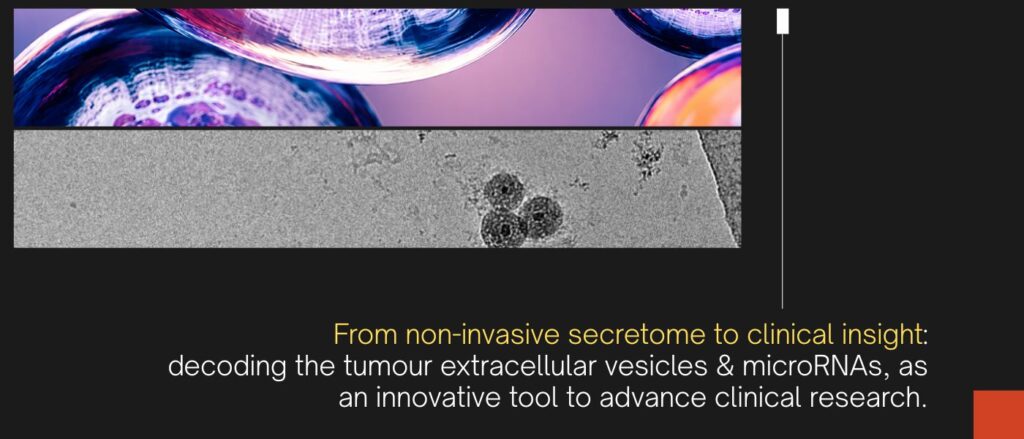
Through the integration of advanced analytical technologies with clinical and pathological data, the team investigates the dynamics, molecular composition, and biological functions of extracellular vesicles, supporting the identification and validation of novel biomarkers with diagnostic, prognostic, and predictive potential. This approach aims to translate molecular findings into clinically tools for patient stratification, disease monitoring, and treatment personalization. Across different clinical settings, these studies seek to support early disease detection, improve risk stratification, monitor treatment response and investigate mechanisms associated with tumour progression and therapeutic resistance.

Research Projects
EXO-RECC
The project focuses on the identification and characterization of exosomes in the serum of patients with renal cancer, investigating their potential as minimally invasive biomarkers. Serum samples from patients and healthy controls will be compared to assess exosome concentration, size distribution, and microRNA content. The analysis will evaluate their association with renal tumour biology, disease progression, treatment response, and clinical monitoring.
EXO-BRCA
The study investigates exosomal microRNAs as potential minimally invasive biomarkers for early breast cancer diagnosis in BRCA1/2 pathogenic mutation carriers. The prospective study will compare serum samples from carriers with active breast cancer Vs cancer-free carriers, identifying differentially expressed miRNAs by microarray and validating 10 selected candidates by Real-Time PCR. The project also includes the development of a Research Use Only EGOT-based biosensor for extracellular vesicle detection and quantification.
EXO-GASTRO
The project investigates circulating tumour nucleic acids as minimally invasive biomarkers in resectable gastroesophageal adenocarcinoma. Serial plasma samples collected before neoadjuvant chemotherapy, before surgery and in the early postoperative period are analysed by next-generation sequencing to detect genomic and transcriptomic alterations, including single-nucleotide variants, insertions/deletions, copy-number variations and gene fusions, and are compared with matched tumour tissue profiles. The study aims to assess treatment response, minimal residual disease, recurrence risk and survival.
EXO-H&N
The study investigates circulating exosomes as minimally invasive biomarkers in head and neck squamous cell carcinoma. Plasma samples from patients at different disease stages and healthy controls will be analysed to assess exosome concentration, physical characteristics, and molecular profile. In patients receiving immunotherapy, serial sampling at predefined time points will evaluate treatment-related changes and their association with prognostic factors and clinical outcomes.
EXO-PRO
The project investigates extracellular vesicles and their microRNA cargo as minimally invasive biomarkers in hormone-sensitive prostate cancer. Serial serum samples from patients, collected at baseline, during treatment and at PSA nadir, are analysed for EV concentration and size by NTA, tetraspanin expression by Leprechaun technology, and a selected panel of 11 miRNAs by Real-Time PCR. The study aims to correlate EV and miRNA dynamics with tumour burden, treatment response and clinical outcomes, supporting risk stratification and personalized disease monitoring.
EXO-BREAST
The study investigates circulating exosomes and their microRNA cargo as minimally invasive biomarkers in breast cancer. Serum samples from participants—including patients with early-stage, metastatic or previous breast cancer and healthy controls—are analysed for exosome concentration and size using ZetaView, and for miR-21 and miR-105 expression by Real-Time PCR. The study aims to correlate exosomal profiles with disease stage, hormone receptor status, HER2, Mib1, event-free survival and overall survival.
ELETTRA
The ELETTRA Study investigates extracellular vesicles and circulating tumour cells as minimally invasive biomarkers for early and personalized breast cancer diagnosis. The prospective study will enroll 56 women, including BRCA1/2 mutation carriers and wild-type participants, with and without breast cancer, and will characterize EV size, concentration, surface markers and miRNA cargo, together with the phenotypic and molecular profile of CTCs. Molecular findings will be correlated with treatment response, disease progression, recurrence and survival to develop a biomarker panel for risk stratification, early detection and personalized therapeutic decision-making.

We will also incorporate secretome characterization into additional preclinical projects with strong translational potential, developed in collaboration with research institutions and clinical partners across the European Union. Through these collaborations, we aim to facilitate the translation of laboratory findings into clinical applications.